The Chalk Ladder: Why Stretton’s Darts Board Is Really a Guest Book With a Bullseye
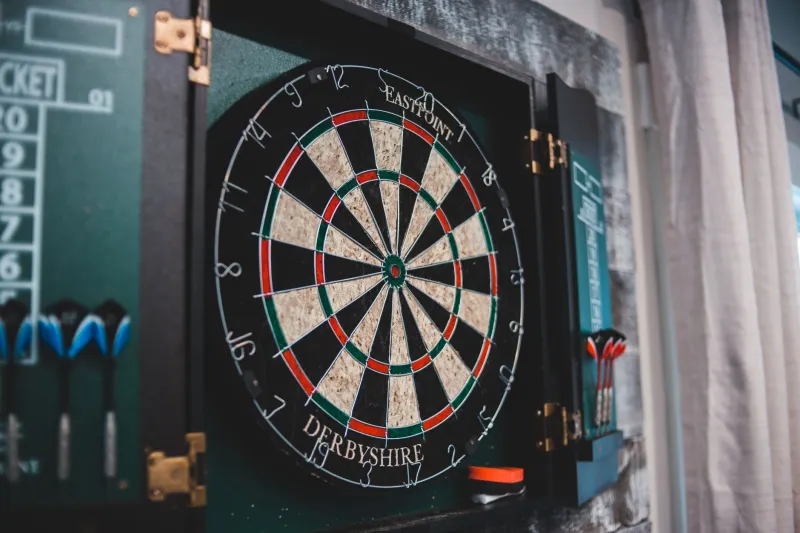
On a damp Tuesday in November, the back room of Stretton Social Club has the particular hush of a place warming up. Chairs are being shifted. A tray of glasses lands somewhere near the hatch. And on the wall beside the darts board, under a light that is slightly too bright for the rest of the room, the chalk ladder is waiting to be updated.
It is not much to look at. A grid of names, a few arrows, the odd asterisk and one smudged line where somebody leaned against the wall mid-conversation. But spend an hour near the oche and you realise the ladder is doing something bigger than sorting out fixtures. It is a small, handwritten record of who turns up, who is new, who is due a game and who has been quietly talked into having a go for the first time.
A List You Can Smudge
Most club noticeboards are formal things. Fixtures, opening times, a reminder about the quiz. The darts ladder is looser than that. Names are added in pencil or chalk depending on who is holding the pen, and they are rearranged with the sort of casual urgency that only exists in a room where everybody knows the shorthand.
You might see a name at the bottom one week and halfway up the next. Nobody makes a fuss about it. The ladder is not a league table with lawyers attached. It is a working list, and working lists get smudged. Somebody rubs out a line with the side of a hand. Somebody else adds a note in the margin. The whole thing has the look of a kitchen calendar that has been relied on for years.
That is part of its charm. A printed sheet would be neater, but it would also be less honest. The chalk ladder shows its age. It shows that people have stood here, argued gently, laughed and changed their minds. In a club like Stretton’s, that counts for something.
The Long Walk to the Oche
The walk from the bar to the darts board is not actually long. Maybe ten paces, depending on how many chairs have been pulled out. But it has its own ritual. You finish your drink, or you put it down with intent. You collect the darts. You check who is next. Then you make the short journey across the carpet while somebody gives you a running update on the ladder, whether you asked for one or not.
That walk is where a lot of the social business gets done. A newcomer might be pointed towards the board and told, with great seriousness, that the rules are simple and the ladder is simpler. A regular might be reminded that they still owe somebody a game from three weeks ago. There is banter, but it is the soft kind. The kind that makes room for you rather than scoring a point off you.
And then there is the throwing itself. Not the professional stuff. The real stuff. A dart that lands just outside the board. A lucky double. A round of applause that is more affectionate than amazed. The ladder is the reason people are standing there, but it is not the point. The point is that somebody is standing there with you.
Challenges, Not Call-Outs
On paper, the ladder is about challenges. You play the person above you, you win, you move up, you wait for the next game. In practice, it is much more polite than that. People ask. People check. People say things like, are you free for a quick one, or, I think I owe you from last month. The ladder gives everyone an excuse to start a conversation without having to make one out of thin air.
That matters more than it sounds. Walking into a club on your own can be the hardest part of the night. A darts ladder is a useful bridge. It gives you a reason to say hello to somebody you have only nodded at before. It gives the regulars a way to bring you in without making a performance of it. The chalk does the introducing, and the people do the rest.
There is a lovely bit of theatre in the way a challenge gets settled, too. Somebody looks at the board. Somebody else says they thought that game had already been played. A third person, usually from the far side of the room, offers an opinion that nobody requested. The whole thing is resolved in under a minute, with no hard feelings and at least one joke about eyesight or elbows.
The Handwriting of a Neighbourhood
Look closely at the ladder and you can read the room. There are names in bold chalk from somebody who wanted to make sure they were counted. There are small, neat entries from a person who clearly respects a straight line. There are nicknames that make no sense until you have been in the club for a few weeks. There is always one name that has been rewritten so many times it has become a small work of abstract art.
In that way, the board is a kind of guest book. Not the formal sort you sign at a wedding. The everyday sort. It records the people who keep the place going: the ones who arrive early to set up, the ones who only come for the darts, the ones who said they were not playing and then had a go anyway. It is a neighbourhood diary written in chalk, and it is updated every week whether anybody admits to reading it or not.
Newcomers get added. Regulars get moved. Somebody rubs out a name that has not been seen for a while, not to erase them, but because the list needs to keep moving. And then, a few weeks later, that name reappears at the bottom and everybody says they knew it would.
Why a Chalkboard Still Works
A darts ladder is not a grand idea. It is a practical one. But practical things can become important when they are wrapped up in the life of a room. The ladder gives Stretton Social Club a structure for its Tuesday nights, a way of making sure nobody is left standing at the edge, and a small, smudged reason to come back next week.
So the next time you are in and the board is being updated, take a look. It might not look like much. But it is the club’s own handwriting, and it is still the best guest book in Stretton.